
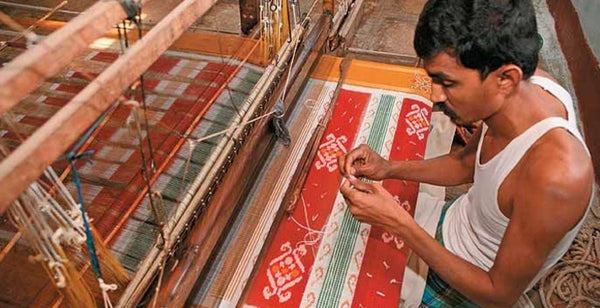
Is Khandua Pata losing its essence or planning a comeback?
It is loved, respected, and sacred in many respects. It is woven in the tiny villages of Maniabandha and Nuapatna, and it contains centuries' worth of identity, artistry, and devotion.

The Khandua Pata is a textile that subtly but effectively conveys the cultural essence of Odisha, a state where tradition is not only upheld but also lived. Khandua is more than just clothing, in contrast to other textiles. It is loved, respected, and sacred in many respects. It is woven in the tiny villages of Maniabandha and Nuapatna, and it contains centuries’ worth of identity, artistry, and devotion.
The traditional handwoven silk fabric known as Khandua Pata is frequently dyed in rich, organic colors; the most famous of these is a deep vermilion red that comes from natural sources. It is made using a process called ikat, in which the yarns are precisely tied and dyed before being woven to reveal elaborate patterns. However, Khandua has a particularly close relationship with the divine, in contrast to many other ikats in India. It has been Lord Jagannath of Puri’s preferred fabric for many generations. This fabric is made for the gods, not just for humans.
Every stage of its creation involves a subtle spirituality. The weavers, many of whom come from families that have been doing this for hundreds of years, consider themselves more than just artisans. They consider themselves to be carrying out a holy obligation. Some Khandua pieces are embellished with passages from the devotional poetry of the 12th-century poet Jayadeva, known as the Gita Govinda. Others feature traditional designs such as peacocks, wheels, elephants, and conch shells—symbols that are ingrained in the Odia cultural imagination.
It’s a laborious process that calls for patience and accuracy. Before a single weave can start, threads must be precisely tied and dyed in order to design a single Khandua cloth. This approach requires both technical proficiency and a nearly meditative focus. Every thread that goes through the loom carries the rhythm of generations, and each fabric may take weeks to complete.
However, the future of Khandua weaving remains uncertain despite its significance and beauty. Many traditional weavers find it difficult to make a living as machine-made textiles and changing consumer preferences become more prevalent. The looms that once reverberated through villages are now occasionally silent as younger generations are drawn to more secure urban jobs. There is a chance that the information that was previously transmitted from parent to child will be forgotten.
But there’s a silent comeback. The distinctiveness of Khandua is starting to be acknowledged by designers, academics, and cultural activists. This fabric is becoming more well-known not just in India but also globally thanks to ethical fashion movements and sustainable apparel projects. Fashion runways, boutique stores, and heritage collections are all featuring reimagined Khandua sarees and stoles, giving a long-standing craft a new lease on life.
Wearing a piece of Khandua is more than just a style statement. It is to immerse oneself in a narrative and experience the passion and effort of craftspeople who woven prayers into silk in addition to designs. It is to establish a brief but meaningful connection with the timeless spirit of Odisha, a spirit that communicates through sacred cloth, color, and rhythm.
There is a silent song of devotion, identity, and fortitude in every Khandua. And the tradition will never really die as long as people hear that song.
