
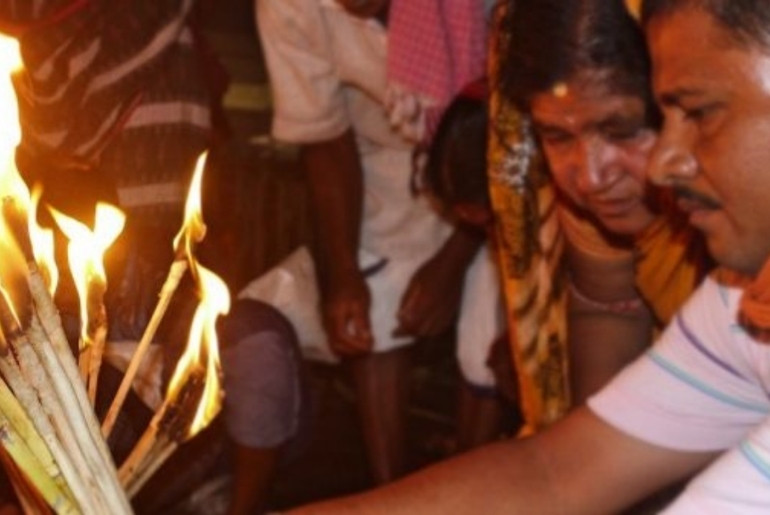

Also known as the Festival of Lights, Diwali holds a luminous place in India’s cultural and spiritual fabric. While the celebration takes on diverse forms across the country, the eastern state of Odisha observes a ritual that blends devotion, memory, and light, Bada Badua Daka. This ancient tradition stands apart as a heartfelt ceremony where families reach out to their departed ancestors, inviting them to share in the festival’s joy and seeking their blessings for the days ahead.
Deeply rooted in Odia culture, Bada Badua Daka is both a private and communal act of remembrance. Though families perform the ritual within their homes, the most striking public observance unfolds before the Jagannath Temple in Puri, where thousands gather under the night sky, flames flickering in reverence. While visitors can respectfully witness this collective moment, it remains an intimate spiritual practice, not a spectacle for tourist participation.
At the centre of the ritual lies the burning of Kaunria Kathi, bundles of dried jute sticks. As the sticks ignite, their soft glow is believed to guide ancestral souls from Pitru Lok, the realm of the forefathers, toward the warmth of earthly light. Each flame becomes a symbol of remembrance, connection, and gratitude, a bridge between generations.
Families raise their burning jute sticks and recite the age-old invocation: “Bada badua ho, andhaara re aasa, alua re jaa,”
which translates to, “Oh ancestors, come from darkness, go towards the light.”
This chant resonates through the air, carrying both spiritual energy and emotional depth. It signifies the soul’s journey from darkness to enlightenment, mirroring Diwali’s own essence of triumph over ignorance and despair.
The origins of Bada Badua Daka remain cloaked in mystery. Some trace its beginnings to the Bhakti movement led by Chaitanya Mahaprabhu around 500 years ago, while others believe it dates as far back as 350 BC, connected to the return of the Sadhabas, ancient Odia seafarers who set sail for trade and returned home to celebrate their safe voyages.
Today, the ritual endures as one of Odisha’s most poignant expressions of Diwali, where light not only dispels darkness but also illuminates the eternal bond between the living and the departed.
