
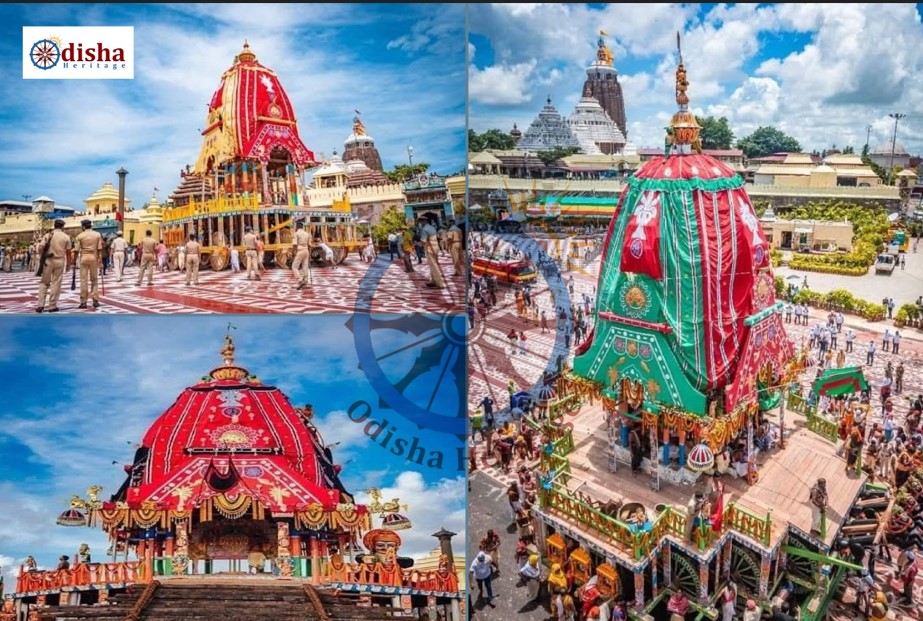

The Ratha Jatra of Puri is not only a grand festival of faith but also a celebration of the unique significance of the three sacred chariots — Taladhwaja, Darpadalana and Nandighosa. Every year, Lord Balabhadra, Devi Subhadra and Lord Jagannath leave the Jagannath Temple and travel to the Gundicha Temple in their respective chariots. The annual journey, scheduled this year on July 16, 2026, covers nearly three kilometres along the Bada Danda of Puri and draws millions of devotees from across the world.
One of the most remarkable aspects of Ratha Jatra is that all three chariots are built afresh every year. None of the chariots are reused. Constructed entirely from wood and decorated with colourful cloth, carvings and traditional motifs, they together represent the rich heritage, craftsmanship and spiritual traditions of Odisha. The three chariots have a total of 42 wheels and are built using more than 2,000 pieces of wood and around 1,090 metres of fabric.
Taladhwaja: Chariot of Lord Balabhadra
Taladhwaja is the chariot of Lord Balabhadra and is the first to move in the Ratha Jatra procession. The name Taladhwaja refers to the palm or bamboo symbol displayed on its flag. The chariot is around 44 feet high and has 14 wheels.
Made from 763 pieces of wood, Taladhwaja is covered with red and green cloth. Its charioteer is Matali and it is pulled by four black horses named Tribra, Ghora, Dirghasharma and Swornanava. The guardian deity of the chariot is Vasudeva. The chariot is also decorated with several side deities, including Ganesha, Kartikeya and Mrutyunjaya. As Lord Balabhadra is the elder brother, Taladhwaja leads the procession.
Darpadalana: Chariot of Devi Subhadra
Darpadalana, also known as Devadalana, is the chariot of Devi Subhadra. Meaning “the trampler of pride,” it is the smallest of the three chariots but holds equal religious importance. The chariot is about 43 feet high and moves on 12 wheels.
Constructed from 593 pieces of wood, Darpadalana is decorated with red and black cloth. The guardian deity of the chariot is Jayadurga, while Arjuna serves as its symbolic charioteer. The four red horses attached to the chariot are named Rochika, Mochika, Jita and Aparajita. The black colour of the canopy is associated with the primordial feminine energy in Shakta tradition.
Nandighosa: Chariot of Lord Jagannath
Nandighosa, the chariot of Lord Jagannath, is the largest among the three. It stands about 45 feet high and moves on 16 wheels, each measuring seven feet in diameter. The chariot is decorated with red and yellow cloth, symbolising Lord Jagannath’s association with Lord Krishna.
Built using 832 pieces of wood, Nandighosa carries the flag Trailokyamohini. Its charioteer is Daruka and it is drawn by four white horses named Samkha, Rochika, Mochika and Jwalani. The chariot is adorned with several side deities, including Varaha, Narasimha, Rama, Narayana and Hanuman. During the journey, Nandighosa traditionally pauses near the samadhi of Bhakta Salabega, the renowned devotee of Lord Jagannath.
A Tradition of Unique Craftsmanship
The construction of the three chariots begins every year on Akshaya Tritiya following the principles of the ancient Silpashastra. Different varieties of wood, including Phasi, Dhaura, Asan, Simili, Mahanimba, Gabhari and Kadamba, are used in the process.
The wheels are built first and later attached to the axles in a ritual known as Chaka Dera. The chariots are assembled using traditional wooden joinery and coconut-fibre ropes, without the use of metal nails in the main structure. Artisans also carve wooden doorkeepers, charioteers and flag deities for each chariot. Finally, more than 1,090 metres of colourful fabric, much of it produced in Pipili, is used to decorate the completed chariots.
The annual creation of Taladhwaja, Darpadalana and Nandighosa reflects the enduring faith, craftsmanship and cultural heritage associated with the world-famous Rath Yatra of Puri.
