
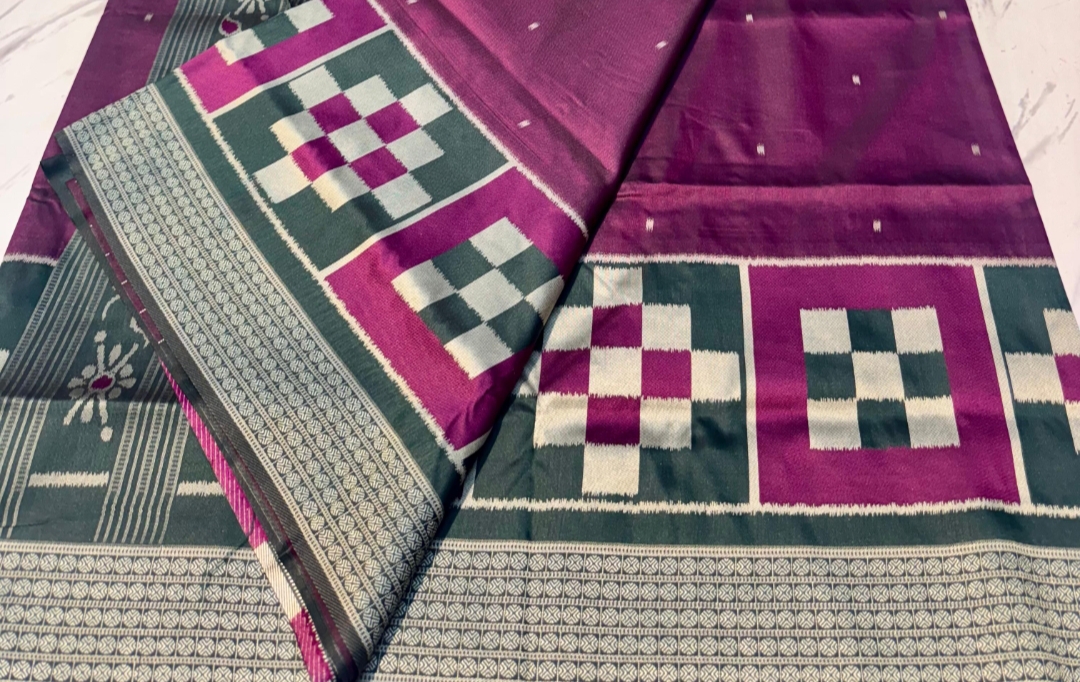

The history of the Pasapali saree dates back to the 16th century, during the reign of Mughal emperor Akbar. When Akbar invaded Odisha, he was deeply impressed by the exquisite handloom fabrics of the region. Fascinated by their craftsmanship, he invited skilled weavers to his court, encouraging them to flourish under royal patronage. This cultural exchange also introduced Persian influences into Odisha’s handloom traditions.
Among the weavers was Bhagabat Meher of the Meher community in Bomkai village. At Akbar’s court, he learned the extra weft technique from Persian artisans and began blending it with local weaving practices. Incorporating motifs such as paisley and lotus, which reflected Mughal aesthetics, he developed a distinctive style. Upon returning to his village, Bhagabat Meher passed on this knowledge to his community, laying the foundation for what became the celebrated Pasapali saree.
The name Pasapali comes from two words: pasa (meaning chessboard) and pali (meaning border). True to its name, the saree is known for its striking checkered designs, created using contrasting threads in the extra weft technique. Beyond its visual appeal, the checkered border is considered auspicious and symbolic of good fortune in Odisha’s cultural traditions.
Over time, Pasapali sarees gained immense popularity among Odisha’s royal families and nobility, particularly under Maharaja Krushna Chandra Gajapati Narayan Dev (1892–1974), a great patron of arts and culture. He promoted the saree as an emblem of Odisha’s identity and heritage, gifting it to dignitaries and visitors from across India and abroad.
Today, the Pasapali saree is regarded as one of India’s finest handloom creations. Showcased at national and international exhibitions, it has graced the wardrobes of many eminent personalities, including former Prime Minister Indira Gandhi, former President Pratibha Patil and actress Aishwarya Rai Bachchan. With its rich history, cultural symbolism, and timeless artistry, the Pasapali saree continues to stand as a proud representation of Odisha’s weaving legacy.
