
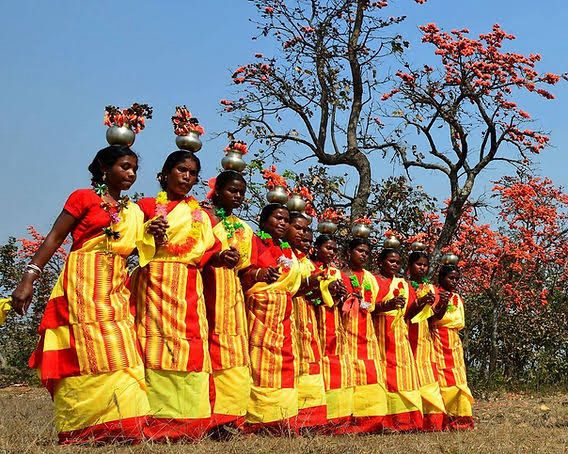
The Santali People: A Tapestry of Totems, Stars, and Stories
Spread across Jharkhand, Odisha, West Bengal, Bihar, and parts of Bangladesh and Nepal, the Santals preserve a distinct heritage defined by tradition, music, and reverence for the natural world.

Among the many indigenous communities of India, the Santal or Santhali people stand out for their rich cultural identity, unique clan structure, and deep connection to nature and the cosmos. Spread across Jharkhand, Odisha, West Bengal, Bihar, and parts of Bangladesh and Nepal, the Santals preserve a distinct heritage defined by tradition, music, and reverence for the natural world.
The Santali society is divided into twelve clans—Hansdak, Murmu, Hembrom, Soren, Kisku, Tudu, Marandi, Baske, Besra, Chonre, Puria, and Bedea—each identified by a surname and a corresponding totem. These totems, mostly animals or plants, are more than mere symbols; they are sacred, woven into the fabric of clan duties, taboos, and stories. Every clan respects its totem deeply, never harming or consuming it, and often aligning its values and lifestyle with that of the creature or symbol they revere.
For example, the Hansdak clan, considered the most senior, carries the wild goose or swan as its totem. The name itself is drawn from the Santhali word hans (wild goose) and dak (water), linking the clan to the myth of creation and primal waters. The Murmu clan, on the other hand, associates with the antelope—the first animal ever hunted by the Santals—connecting the clan to the roots of survival and tradition. The Baske clan worships the leopard, symbolizing leadership and high chieftainship, yet is bound by the curious taboo of never eating stale rice, a dish they once offered to the gods.
The Hembrom clan breaks away from animal symbolism with a totem of betel nut, a revered object in many Indian rituals. Meanwhile, the Marandi clan honors saramollagrass, also known as Ischaemum rugosum, which reflects their history as traders and providers of forage. The Soren clan carries the rare honor of being linked not to a beast but to the sky itself—specifically, the Pleiades constellation. Traditionally considered defenders and medicine keepers, this clan’s starry association sets them apart as celestial guardians.
Musicality flows through the Tudu clan, whose emblem is the owl. In Santali culture, this clan is synonymous with art and melody, often the bearers of traditional songs and dances. The Besra clan looks skyward too, identifying with the fierce besra sparrowhawk, while the Kisku clan, associated with the kingfisher, is one of regal bearing and grace. The Bedea clan, revering the humble sheep, are seen as unpossessive and communal, living lives aligned with simplicity.
These totems are not mere badges—they shape identity, ritual, occupation, and the invisible laws by which a Santal lives. In a world increasingly detached from nature, the Santhals serve as a vibrant reminder of how deeply our roots can run in the soil, the stars, and the stories passed down through generations.
As India celebrates its diverse indigenous communities, today holds special significance—it is the birthday of the country’s 15th President, Droupadi Murmu, herself a proud daughter of the Santhal soil and a member of the Murmu clan. Her rise from the remote villages of Odisha to the highest constitutional office in the land is not just a personal triumph, but a powerful symbol of representation for millions of tribal Indians whose voices have long remained on the margins. On this day, her story stands tall as a living testament to the strength, dignity, and enduring legacy of the Santhali people.
